What Are Virtual Power Plants (VPPs)?
Published by:
Published on:
Adam S.
Table of Contents
The electricity market is entering a new operating era. For more than a century, the grid was built around a simple assumption: large power plants would generate electricity, transmission lines would move it over long distances, and customers would consume it. That model worked when demand was predictable, generation was centralized, and homes had few energy assets behind the meter.
That world is changing. Solar panels, home batteries, electric vehicles, smart thermostats, heat pumps, and controllable appliances are turning homes and businesses into active energy assets. The strategic question is no longer whether distributed energy resources will grow. They already are. The question is whether these assets will remain fragmented, or whether they will be coordinated into something more valuable.
That is the promise of virtual power plants.
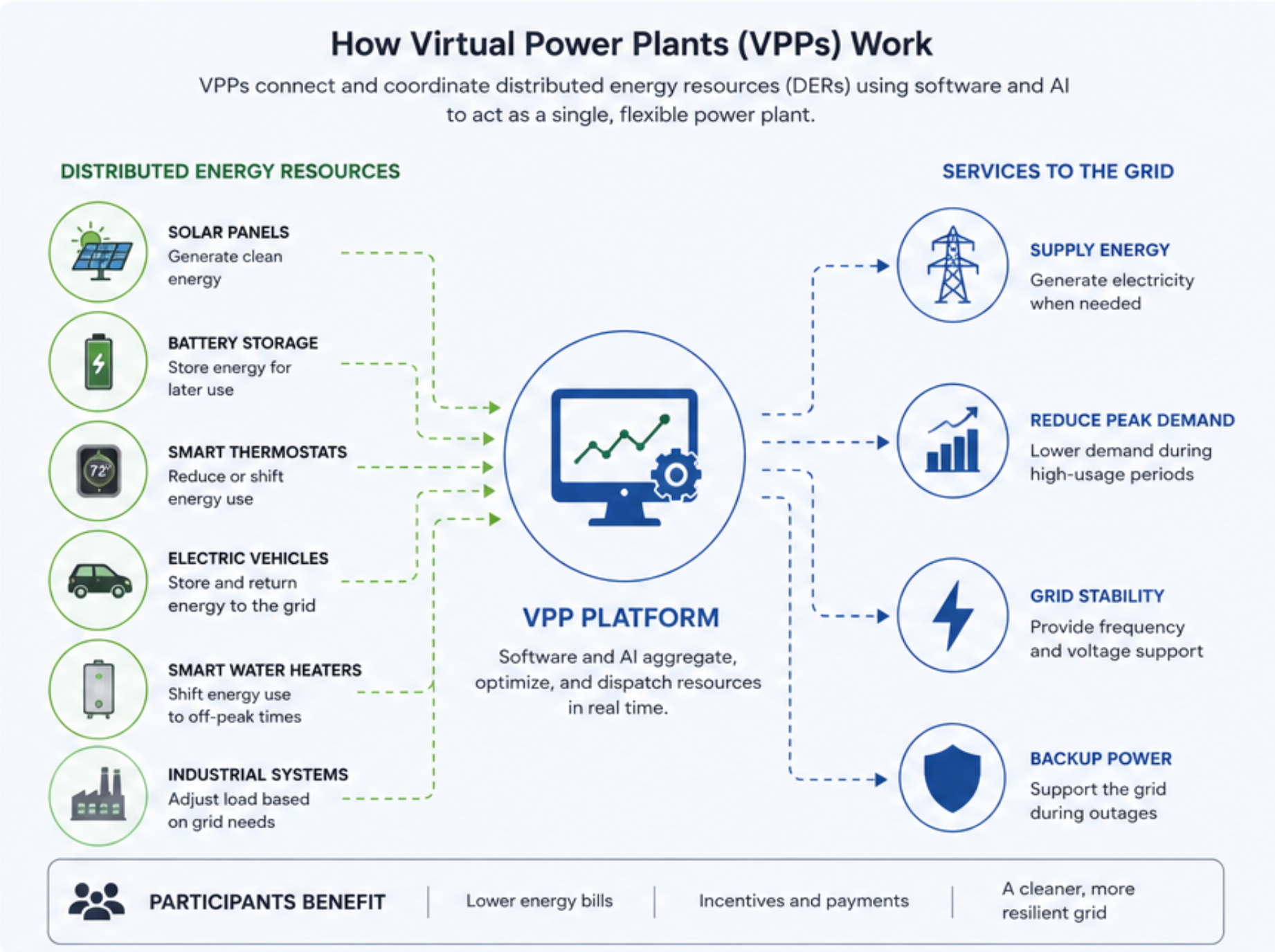
Virtual power plants, often shortened to VPPs, are networks of distributed energy resources connected by software and operated as if they were a single, flexible power plant. A VPP can draw on many small assets—solar systems, batteries, EV chargers, thermostats, commercial loads, and smart devices—and coordinate them to reduce peak demand, store excess electricity, discharge energy when the grid needs support, or shift consumption to better times of day.
In practical terms, virtual power plants convert flexibility into capacity. A homeowner with solar and a battery may see a backup system. A utility may see dispatchable grid support. A grid operator may see a way to avoid firing up an expensive peaker plant. A policymaker may see a lower-cost path to electrification. The asset is the same; the business model is different.
The Grid Was Designed for a Simpler Problem
The traditional grid was designed for one-way power flow. Electricity moved from centralized generation to passive customers. Planning was built around forecasts: how much generation would be needed on the hottest afternoon, the coldest evening, or the most demanding hour of the year.
But the grid is now being asked to solve a more complex problem. Demand is becoming more dynamic as transportation, heating, cooling, and household technology electrify. Supply is becoming more variable as solar and wind represent a larger share of generation. At the same time, local distribution systems are under pressure from aging infrastructure, extreme weather, and rising customer expectations for reliability.
Virtual power plants matter because they give the grid a new option: instead of only building more centralized supply, utilities can coordinate flexible demand and distributed storage. A VPP does not replace every conventional power plant, transmission upgrade, or utility-scale battery. But virtual power plants can reduce the number of expensive hours when the grid is most strained.
That distinction is important. Most of the grid is not stressed all the time. It is stressed during specific windows: a heat wave, a winter peak, an evening ramp after solar production falls, a local feeder constraint, or an outage event. A well-designed VPP is valuable because it can respond during those windows.
How Virtual Power Plants Work
A VPP has three layers.
The first layer is the physical asset base. This includes rooftop solar, home batteries, EV chargers, smart thermostats, smart water heaters, commercial HVAC systems, industrial loads, and other distributed energy resources. On their own, these assets are small. In aggregate, they can be meaningful.
The second layer is the software platform. The VPP platform monitors enrolled assets, forecasts available capacity, respects customer preferences, and decides when to charge, discharge, reduce load, or shift consumption. The software is what turns disconnected devices into coordinated capacity.
The third layer is the market or utility interface. Virtual power plants need a buyer for their flexibility. That buyer may be a utility trying to reduce local peak demand, a grid operator procuring capacity, a retailer managing energy costs, or a program administrator paying customers for participation. Without a commercial structure, a VPP is merely a control system. With the right structure, virtual power plants become an energy-market product.
Consider a summer afternoon. Thousands of homes have batteries, smart thermostats, and EV chargers. Individually, each home may only shift a small amount of electricity. But if a VPP pre-cools homes slightly before the peak, delays some EV charging, and discharges batteries during the highest-cost hours, the combined effect can reduce demand at power-plant scale. The customer may not notice a meaningful change in comfort, but the grid experiences a measurable reduction in stress.
This is the operational logic of virtual power plants: small actions, coordinated at scale, delivered at the moment when flexibility is most valuable.
Why VPPs Are Becoming Strategically Important
Virtual power plants are not simply a technology trend. They are a response to a structural mismatch in the energy system.
On one side, customers are buying distributed energy resources for personal reasons: lower bills, backup power, cleaner energy, EV ownership, and greater control. On the other side, utilities need flexible capacity that can be deployed quickly and cost-effectively. VPPs connect those two markets.
For homeowners, a VPP can transform a battery from a passive backup device into an income-producing or bill-reducing asset. For utilities, a VPP can reduce peak demand, defer grid upgrades, improve local reliability, and make better use of existing infrastructure. For energy markets, virtual power plants can add flexible capacity without waiting years for new centralized assets to be built and interconnected.
This is why the economics are compelling. A traditional peaker plant is built to run during limited high-demand periods. That means customers pay for capacity that may sit idle most of the year. A VPP, by contrast, uses assets that customers are already buying for their own purposes. The incremental value comes from coordination. Virtual power plants are not free, but they can be capital efficient because the grid is leveraging distributed assets rather than owning every asset directly.
The result is a shift from asset ownership to asset orchestration. In the old grid, value came from building large physical capacity. In the emerging grid, value also comes from aggregating, forecasting, dispatching, and monetizing distributed flexibility.
What Counts as a VPP Asset?
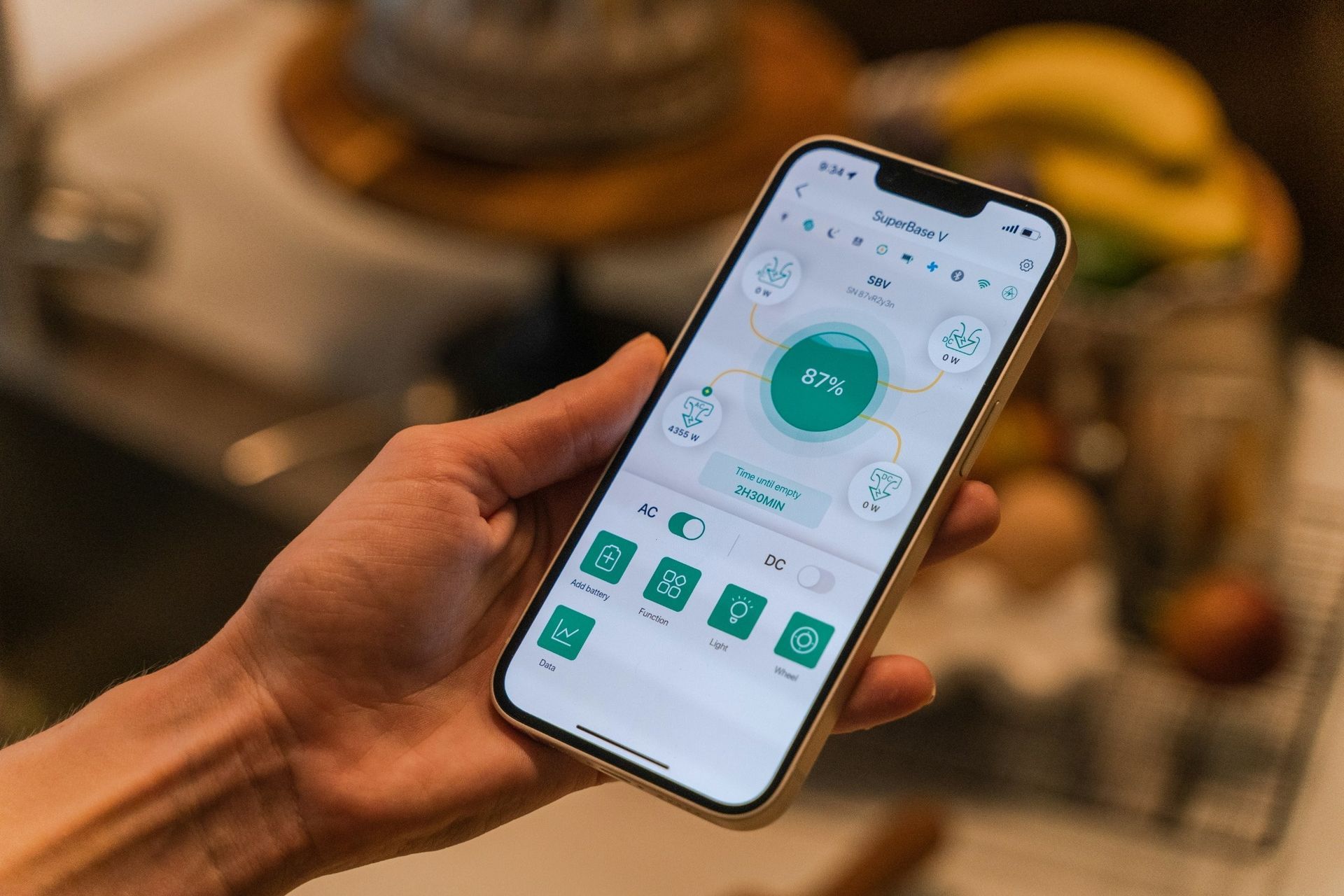
The most visible VPP assets are solar-plus-storage systems. Solar produces electricity during the day. Batteries store excess energy and can discharge later when prices are higher, demand is elevated, or the grid needs support. For many homeowners, this is the clearest entry point into virtual power plants.
But VPPs are broader than solar and batteries. Smart thermostats can shift air-conditioning load. EV chargers can delay charging until off-peak hours. Electric vehicles, where vehicle-to-grid programs are available, may eventually export stored energy back to the grid. Smart water heaters can store thermal energy by heating water when electricity is abundant and pausing during peak periods. Commercial buildings can adjust HVAC, refrigeration, lighting, and industrial processes within defined limits.
The diversity of assets is a strength. A VPP made only of one technology may be useful, but virtual power plants become more resilient when they combine generation, storage, and flexible demand. The best VPP designs are portfolio strategies. They do not depend on every asset doing the same thing at the same time.
The Customer Contract is the Business Model
The technical case for virtual power plants is strong, but the commercial case depends on trust. Customers will not enroll in a VPP if they believe they are losing control of their home, comfort, battery, or EV charging schedule.
That means customer design is not a secondary issue. It is the product.
A strong VPP program gives customers clear choices, transparent compensation, simple enrollment, data privacy protections, and the ability to override events when needed. The best VPP programs are not framed as sacrifice. They are framed as partnership: the customer shares flexibility when it matters, and in return receives savings, incentives, resilience, or better use of their energy system.
This matters for solar and battery adoption. A homeowner may already understand the value of lowering an electric bill. The additional VPP value is more nuanced. It requires explaining that a battery can serve the home and the grid, that EV charging can be optimized without inconvenience, and that flexible energy use can be monetized.
For APG, this is where advisory work becomes important. Homeowners should not evaluate solar, batteries, and EV charging only as equipment purchases. They should evaluate them as energy assets that may participate in future grid programs. A system designed only for today’s bill savings may leave value on the table. A system designed with VPP readiness in mind can preserve optionality.
The Risks Are Real
Virtual power plants are promising, but they are not magic. A VPP still needs rigorous measurement, reliable dispatch, cybersecurity, customer retention, and regulatory approval. If a utility cannot count on a VPP during a critical grid event, the VPP will not be valued like dependable capacity. If customers leave the program, override too frequently, or do not understand the terms, the portfolio becomes less reliable.
There are also equity questions. Virtual power plants should not only benefit homeowners who can afford premium solar-plus-storage systems. A broader VPP market can include renters, multifamily buildings, community assets, smart appliances, and commercial loads. If designed well, VPPs can widen participation in the energy transition. If designed poorly, VPPs can reinforce existing access gaps.
Finally, there is the question of regulation. Energy markets were not designed around millions of small devices acting together. Rules for aggregation, compensation, metering, interconnection, and data access will determine how quickly virtual power plants scale. The technology may be ready before the market structure is.
What Homeowners Should Watch
For homeowners considering solar, storage, or EV charging, the practical question is not only “Will this save money?” It is also “Will this system be flexible enough for the next decade of energy markets?”
That means asking different questions:
- Is the battery compatible with utility or third-party VPP programs?
- Can the inverter, charger, or thermostat communicate with approved platforms?
- Are there participation incentives available today?
- Could future incentives improve the economics?
- Will enrolment affect backup reserve settings?
- Can the homeowner opt out of dispatch events?
- How is performance measured?
- Who receives the value: the homeowner, the installer, the aggregator, or the utility?
These questions are not meant to slow the decision. They are meant to improve it. Virtual power plants are turning equipment selection into strategic energy planning. The right system is not simply the cheapest system. It is the system that supports the homeowner’s current needs while keeping future grid value accessible.
Final Thoughts
Virtual power plants represent one of the most important shifts in modern electricity: the move from centralized generation alone to coordinated, distributed flexibility. VPPs allow homes, businesses, and communities to participate in grid operations without becoming power companies themselves.
For utilities, virtual power plants can reduce peak demand, improve resilience, defer infrastructure spending, and support renewable integration. For homeowners, VPPs can improve the economics of solar, batteries, EV charging, and smart home technology. For the broader energy system, virtual power plants create a bridge between private energy investment and public grid value.
The strategic insight is simple: the next power plant may not be a single facility. It may be a network. It may sit across thousands of homes, batteries, chargers, thermostats, and buildings. It may be operated by software, compensated by markets, and measured by flexibility.
That is why virtual power plants deserve attention now. They are not a futuristic concept. They are a practical operating model for a grid that must become cleaner, more resilient, more affordable, and more intelligent. The companies and homeowners who understand VPPs early will be better positioned to capture the next layer of energy value.
SOURCES
1. U.S. Department of Energy — Virtual Power Plants
(https://www.energy.gov/edf/virtual-power-plants)
2. U.S. Department of Energy Loan Programs Office — Virtual Power Plants Projects
(https://www.energy.gov/edf/virtual-power-plants-projects)
3. U.S. Department of Energy — Pathways to Commercial Liftoff: Virtual Power Plants
(https://liftoff.energy.gov/wp-content/uploads/2023/10/LIFTOFF_DOE_VVP_10062023_v4.pdf)
4. Federal Energy Regulatory Commission — FERC Order No. 2222 Explainer
(https://www.ferc.gov/ferc-order-no-2222-explainer-facilitating-participation-electricity-markets-distributed-energy)
5. Federal Energy Regulatory Commission — FERC Order No. 2222 Fact Sheet
(https://www.ferc.gov/media/ferc-order-no-2222-fact-sheet)
6. Lawrence Berkeley National Laboratory — Virtual Power Plants: Insights, Profiles and Inventory
(https://emp.lbl.gov/publications/virtual-power-plants-insights)
7. RMI — Virtual Power Plants, Real Benefits
(https://rmi.org/resources/virtual-power-plants-real-benefits/)
8. The Brattle Group — Real Reliability: The Value of Virtual Power
(https://www.brattle.com/insights-events/publications/real-reliability-the-value-of-virtual-power/)
9. The Brattle Group — Real Reliability: The Value of Virtual Power Full Report
(https://www.brattle.com/wp-content/uploads/2023/04/Real-Reliability-The-Value-of-Virtual-Power-Full-Report.pdf)
10. The Brattle Group — California’s Virtual Power Potential
(https://www.brattle.com/wp-content/uploads/2024/04/Californias-Virtual-Power-Potential-How-Five-Consumer-Technologies-Could-Improve-the-States-Energy-Affordability.pdf)
Share This Article