
What is Net Metering?
Published by:
Published on:
Adam S.
Table of Contents
Solar begins as a technology decision. Panels, batteries, inverters, warranties, roof condition, and installation quality all matter. But the financial performance of a solar energy system is shaped just as much by something less visible: the utility billing structure behind it.
That structure is called net metering.
At its simplest, net metering is a billing arrangement that allows homeowners with solar panels to receive credit for excess electricity their system sends back to the electric grid. The U.S. Department of Energy describes net metering as an arrangement between solar system owners and utilities where system owners are compensated for solar power exported to the grid. It also notes that the old image of a meter simply “running backward” is no longer always accurate, because modern net metering rules vary by state, utility, system size, and credit design.
For homeowners evaluating solar, this distinction matters. Net metering with solar is not just a technical policy. It is one of the primary economic mechanisms that determines how solar turns sunlight into household savings.
What Is Net Metering with Solar?
Net metering is a utility billing method for homes or businesses that generate some of their own electricity, usually through rooftop solar panels. When the solar system produces electricity, the home uses that power first. If the system produces more electricity than the home needs at that moment, the excess electricity flows to the grid. In return, the homeowner receives a bill credit.
The Solar Energy Industries Association describes net metering as a billing mechanism that credits solar energy system owners for electricity they add to the grid. A homeowner may produce more electricity during the day than the home consumes, then use utility power later in the evening when solar production drops. Net metering helps reconcile that mismatch by crediting exported electricity against future consumption.
In practical terms, net metering with solar allows a home to behave less like a passive electricity consumer and more like a small distributed energy asset. The homeowner still relies on the grid, but the relationship changes. The grid is no longer only a source of electricity. It also becomes a place where surplus solar production can be credited.
How Net Metering with Solar Works for a Homeowner
A typical solar day has three phases.
In the morning, the home starts using electricity as the solar system begins producing power. If household demand is higher than solar production, the home imports electricity from the utility.
At midday, solar production often rises. If the system generates more electricity than the home is using, the excess electricity is exported to the grid.
In the evening, solar production falls. The home may use electricity from the utility again, but earlier solar exports may have created credits that help reduce the bill.
The homeowner is then billed based on the “net” amount of electricity used after exports and imports are accounted for. This is why the policy is called net metering. The customer is not simply paying for every kilowatt-hour consumed from the grid in isolation. The bill reflects the balance between electricity imported and electricity exported.
This is one reason solar savings are not determined only by how many panels are installed. Savings depend on when the system produces electricity, when the home uses electricity, what the utility charges for imported electricity, and what the utility credits for exported electricity.
Why Net Metering Matters Economically
Net metering can materially improve the financial case for solar because it increases the value of excess daytime production.
Without some form of export credit, a homeowner would only benefit from the solar electricity used immediately inside the home. Any excess electricity sent to the grid would have limited or no financial value. With net metering, exported solar power can reduce future utility bills.
That means net metering affects several core solar economics:
- It can shorten the payback period.
- It can increase 25-year savings.
- It can make larger systems more financially rational.
It can reduce the need to perfectly match solar production with real-time household consumption.
It can influence whether a battery is financially necessary or primarily a resilience upgrade.
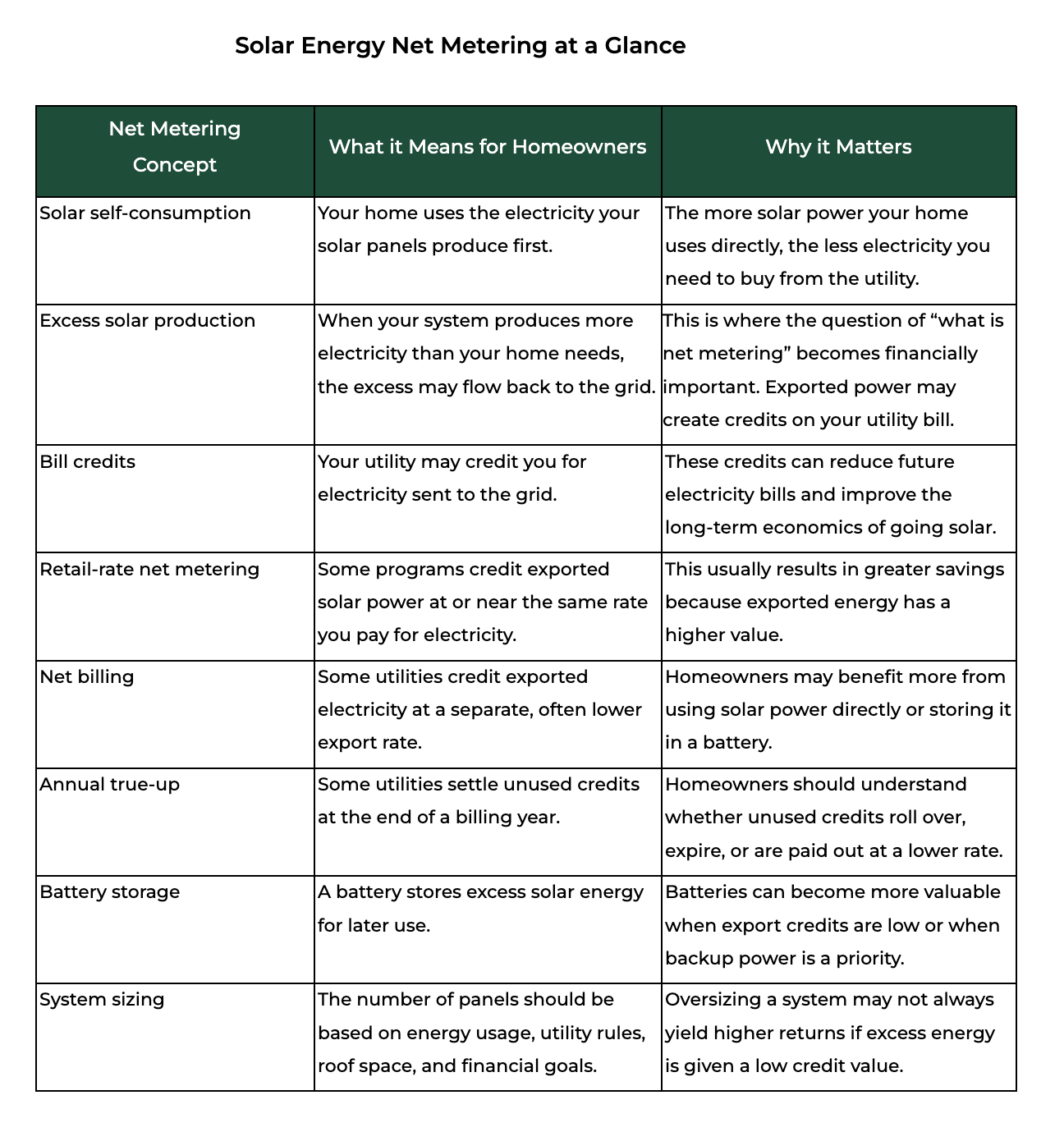
The key issue is the value of the credit. In a traditional retail-rate net metering structure, exported electricity may be credited close to the retail electricity rate. In a different structure, such as net billing, exported electricity may be credited at a lower rate that reflects the utility’s estimated value of that power to the grid. California’s current net billing tariff, for example, credits excess generation at a value-based export rate that is usually lower than the retail import rate, though it can be higher during certain high-value periods.
For homeowners, this creates a strategic question: is the system being designed to maximize total production, maximize self-consumption, optimize bill credits, or support backup power?
Those are not always the same objective.
Net Metering vs. Net Billing
The phrase “net metering” is often used broadly, but the policy landscape has become more complex. Homeowners may encounter several different structures:
Traditional net metering: Excess solar production is credited against future electricity use, often at or near the retail electricity rate.
Net billing: The home still uses its solar power first, but exported electricity is credited at a separate export rate. That export rate may be lower than the retail rate.
Time-of-use compensation: The value of imported and exported electricity may change depending on the time of day.
Annual true-up: Credits may roll over month to month, but unused credits may be settled at the end of the year at a different rate.
These differences can materially change the financial outcome. A 10 kW solar system in one utility territory may perform differently from a 10 kW system in another market, even if the installation cost and sunlight conditions are similar.
This is why Apollo Power Group treats net metering as part of the investment analysis, not as an afterthought. Solar should not be evaluated only by system size and panel cost. It should be evaluated by how the system interacts with the customer’s utility rate structure.
How Net Metering Compares Across the 5 Largest U.S. Solar Markets
When homeowners ask what is net metering with solar, the answer increasingly depends on geography. The largest U.S. solar markets are no longer operating under one uniform model. Some states still offer relatively straightforward net metering. Others have moved toward net billing, export-rate structures, time-of-use requirements, or utility-specific buyback programs.
That matters because two homes with the same system size, installation cost, and annual solar production can produce very different financial outcomes depending on how exported electricity is credited.
According to SEIA’s June 2026 solar data sheet, the five largest U.S. solar markets by cumulative installed solar capacity are California, Texas, Florida, Arizona, and North Carolina.

The Battery Question
Net metering also changes the role of battery storage.
In a strong retail-rate net metering market, the grid can function almost like a financial battery. The homeowner exports excess electricity during the day, receives credits, and uses those credits to offset electricity consumed later.
But when export credits are lower, time-dependent, or less predictable, batteries become more strategically important. A battery allows the homeowner to store excess solar power and use it later, rather than exporting it at a lower value. The Department of Energy notes that storage can help homeowners use solar power when it is needed most, including later in the day or during an outage.
That does not mean every homeowner needs a battery. It means the battery decision should be tied to the homeowner’s goals.
- If the goal is bill reduction, the question is whether storing electricity creates more value than exporting it.
- If the goal is resilience, the question is how much backup capacity the home needs during an outage.
- If the goal is long-term energy control, the question is whether the homeowner wants to reduce dependence on changing utility compensation rules.
The best solar design starts with the homeowner’s actual objective.
The Strategic Mistake Homeowners Should Avoid
The biggest mistake is assuming that all solar savings are created equally.
A homeowner may receive a quote showing attractive projected savings, but those savings depend on assumptions. What electricity rate was used? What export credit was assumed? Does the system rely on annual credit rollover? Are fixed customer charges included? Is the homeowner’s usage pattern realistic? Does the design account for future EV charging, battery storage, or roof limitations?
Net metering is where many of those assumptions become visible.
A solar proposal should answer five questions clearly:
- How much electricity will the system produce annually?
- How much of that electricity will be consumed directly by the home?
- How much will be exported to the grid?
- What credit will the homeowner receive for exported electricity?
- What happens to unused credits at the end of the billing period or year?
If those questions are not answered, the homeowner is not reviewing a complete financial model. They are reviewing a sales estimate.
Final Thoughts
Net metering with solar is one of the most important concepts in residential solar because it defines how excess solar production is valued.
For homeowners, the decision is not simply whether solar panels work. They do. The better question is whether a specific solar system, under a specific utility policy, on a specific home, produces a compelling long-term financial outcome.
That is the difference between buying equipment and making an informed property investment.
Apollo Power Group helps homeowners evaluate solar, battery storage, and EV charging options through that lens. The objective is not to install the largest possible system. The objective is to identify the system that fits the home, the utility rules, the homeowner’s energy profile, and the long-term economics.
In solar, sunlight creates the energy. Net metering helps determine the value.
Solar Net Metering FAQs
What is net metering?
Net metering is a utility billing structure that gives homeowners credit for excess solar electricity their system sends back to the grid.
When your solar panels produce more power than your home needs, that extra electricity may be exported to the utility grid. The utility then applies credits that can help reduce your future electricity bills.
Why does net metering matter when buying solar panels?
Net metering matters because it helps determine the financial value of the electricity your solar system produces.
A solar system does not only save money when your home uses solar power directly. In many markets, it can also create value when excess electricity is exported to the grid.
That is why homeowners asking what is net metering are really asking how solar production turns into long-term savings.
Is net metering with solar the same in every state?
No. Net metering with solar rules vary by state, utility, and rate structure. Some homeowners receive credits close to the retail electricity rate, while others receive lower export credits through net billing or time-based compensation.
This is why Apollo Power Group recommends evaluating what is net metering with solar within your specific utility territory before relying on a solar savings estimate.
Do I still get an electric bill with net metering?
In most cases, yes. Even with net metering, homeowners may still receive an electric bill because utilities often charge fixed fees, grid connection charges, minimum bills, or taxes.
However, net metering credits can reduce the energy portion of the bill. The final bill depends on your electricity usage, solar production, export credits, and local utility rules.
Does net metering make batteries unnecessary?
Not always. In strong net metering markets, the grid can function like a financial storage system because exported solar energy creates credits for later use.
But when export credits are lower, batteries may become more valuable because they allow homeowners to store excess solar electricity and use it later.
For many homeowners, the battery decision depends on whether the goal is savings, backup power, or greater energy control.
SOURCES
1. U.S. Department of Energy — Homeowner’s Guide to Solar (https://www.energy.gov/cmei/systems/homeowners-guide-solar)
2. SEIA — Net Metering
(https://seia.org/net-metering/)
3. SEIA — Solar State by State
(https://seia.org/solar-state-by-state/)
4. SEIA — U.S. Solar Market Insight Report
(https://seia.org/research-resources/us-solar-market-insight/)
5. California Public Utilities Commission — Net Energy Metering and Net Billing
(https://www.cpuc.ca.gov/industries-and-topics/electrical-energy/demand-side-management/customer-generation/net-energy-metering-and-net-billing)
6. California Public Utilities Commission — Net Billing Tariff
(https://www.cpuc.ca.gov/industries-and-topics/electrical-energy/demand-side-management/customer-generation/nem-revisit/net-billing-tariff)
7. Public Utility Commission of Texas — Solar Power
(https://www.puc.texas.gov/consumer-help/electricity/solar/Default.aspx)
8. Florida Administrative Code Rule 25-6.065 — Interconnection and Net Metering of Customer-Owned Renewable Generation
(https://www.law.cornell.edu/regulations/florida/Fla-Admin-Code-Ann-R-25-6-065)
9. Tucson Electric Power — Resource Comparison Proxy Export Rate
(https://www.tep.com/rcp/)
10. North Carolina Public Staff — Net Metering
(https://publicstaff.nc.gov/public-staff-divisions/energy-division/electric-section/net-metering)
Share This Article