Solar Panel Installation Cost in Florida: A Homeowner’s Pricing Guide
Published by:
Published on:
Adam S.
Table of Contents
For many Florida homeowners, solar is no longer a lifestyle purchase. It is a capital allocation decision.
The household is not simply deciding whether to install panels. It is deciding whether to redirect a portion of future utility spending into a home energy asset. That asset may reduce monthly electricity bills, protect against future rate increases, support an EV charger, improve resilience during outages, and potentially strengthen the long-term value proposition of the home.
That is why the most useful way to evaluate Solar Panel Installation Cost in Florida is not to ask, “What is the cheapest system I can buy?” A better question is, “What level of energy control am I purchasing, what risks am I reducing, and how does the investment compare with my current and future cost of electricity?”
Florida is a particularly important market for this question. The state has strong solar resources, high residential air-conditioning demand, a growing population, and recurring storm-related concerns. SEIA reports that Florida has more than 20,900 MWdc of installed solar capacity, ranking the state third nationally, with enough installed solar to power more than 2.49 million homes.
In that context, Solar Panel Installation Cost in Florida should be understood as more than a project quote. It is a household strategy question.
Solar Panel Installation Cost in Florida: The Baseline Homeowners Should Use
The first step is to establish a credible benchmark. As of June 2026, EnergySage reports that the average installed solar panel system in Florida costs approximately $2.16 per watt. For the average Florida system size of 14.56 kW, that equals about $31,499 before available incentives, with a typical price range of roughly $26,774 to $36,224.
That number is useful, but it is not a universal answer. Solar Panel Installation Cost in Florida varies by roof type, system size, electrical complexity, installer margin, equipment quality, utility rules, and whether battery storage is included.
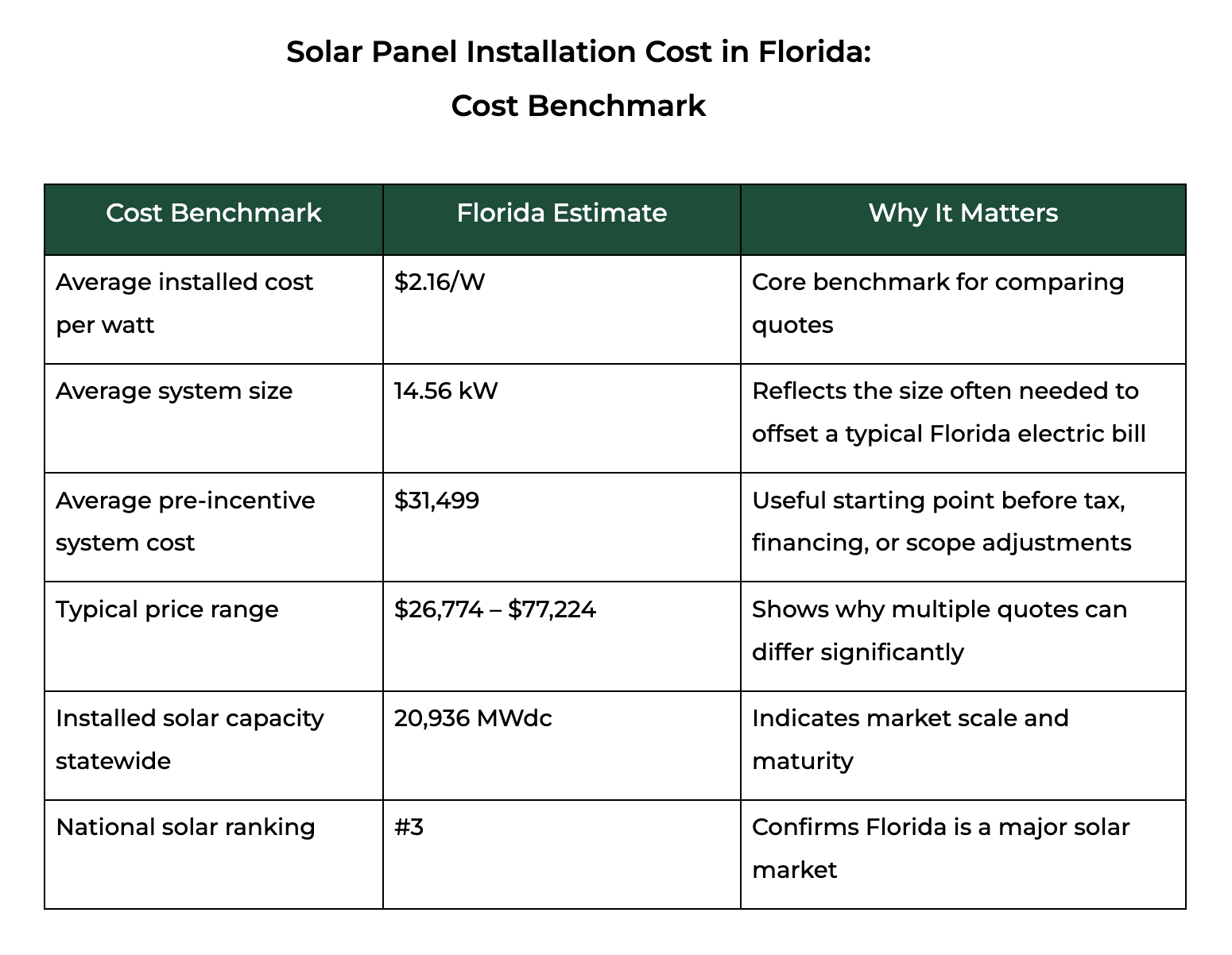
The mistake homeowners often make is treating the average as the answer. It is not. It is the reference point. A homeowner with a simple shingle roof, limited shading, and a modern electrical panel may come in below average. A homeowner with a tile roof, complex roof planes, battery backup, and electrical upgrades may come in above average.
The right conclusion is not that one quote is automatically better than another. The right conclusion is that Solar Panel Installation Cost in Florida must be normalized before it can be compared.
Solar Panel Installation Cost in Florida by System Size and Home Type
The largest driver of cost is system size. A larger home with higher electricity usage usually needs a larger system. But size is only the beginning. Two 12 kW systems can produce very different economics if one is installed on a clean south-facing roof and the other is split across shaded roof planes.
Using the Florida average of $2.16 per watt as an illustrative benchmark, homeowners can estimate the rough pre-incentive cost of different system sizes.
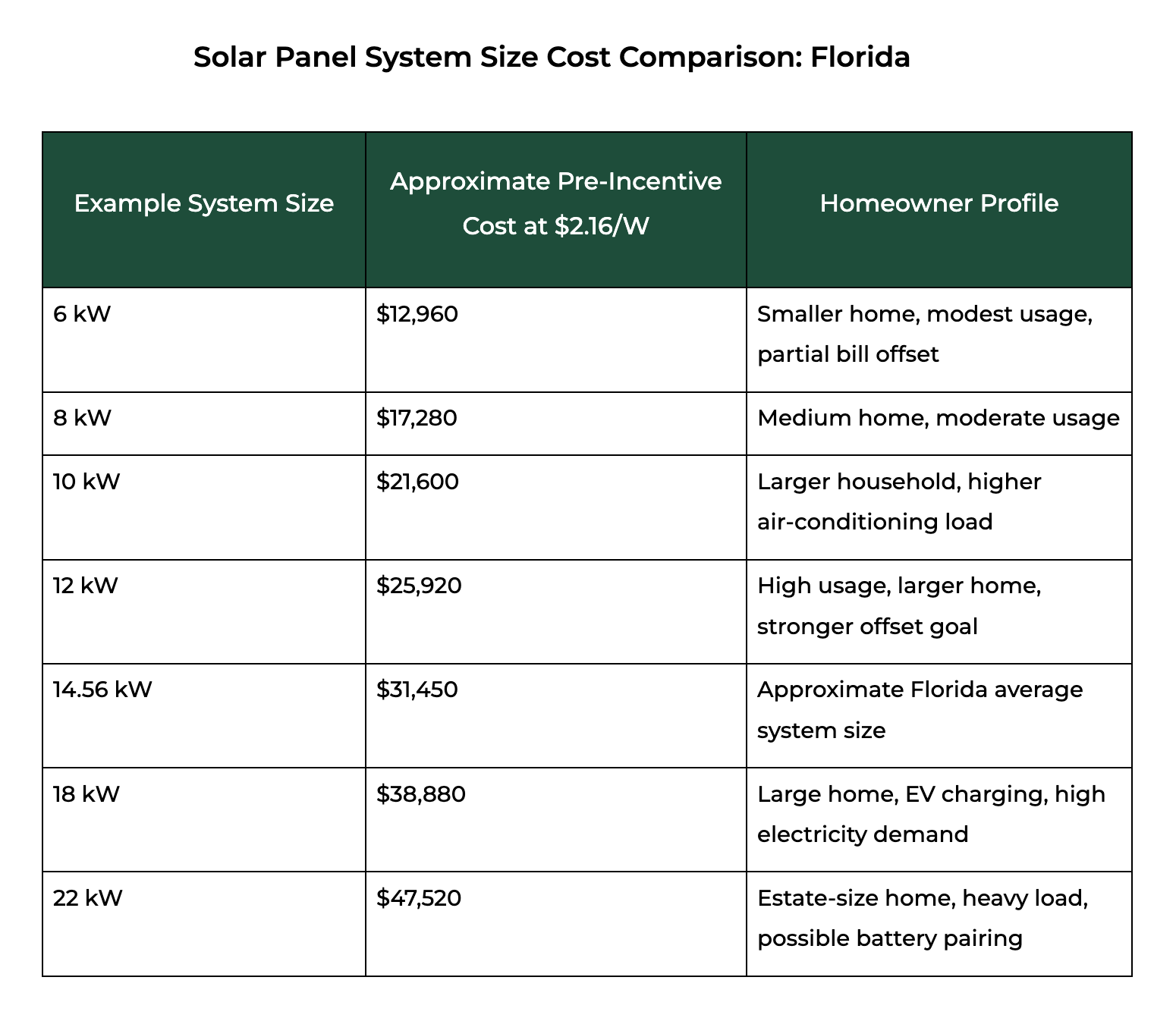
These figures are not quotes. They are planning estimates. Actual Solar Panel Installation Cost in Florida may change materially after a site assessment.
A homeowner should expect the final number to move based on five operational variables.
First, roof type matters. Asphalt shingle roofs are usually more straightforward than tile or flat roofs. Tile roofs often require more care, more labor, and more specialized installation practices. Second, roof age matters. Installing solar on a roof that may need replacement in five years can create unnecessary future removal and reinstallation costs. Third, electrical infrastructure matters. Main panel upgrades, subpanels, backup load panels, or service upgrades can change the economics. Fourth, shading matters. Even a premium panel can underperform if the roof has poor exposure. Fifth, batteries matter. Storage can transform a solar project from a bill-reduction system into a resilience system, but it also increases upfront cost.
This is why quote comparison must be rigorous. A lower price may reflect operational efficiency. It may also reflect excluded work.
The Solar Power Cost Decision: Price Versus Control
The phrase solar power cost is often treated as a single number. That is the wrong frame.
solar power cost has at least four layers: upfront installation cost, financing cost, lifetime maintenance cost, and avoided utility cost. A homeowner who evaluates only the installation quote is looking at the first layer and ignoring the remaining three.
The better approach is to compare solar power cost against the homeowner’s current cost of electricity and expected future exposure. In Florida, this is especially relevant because electricity usage can be significant during hot months. Air conditioning, pool pumps, refrigeration, EV charging, and larger home footprints can all push energy consumption higher.
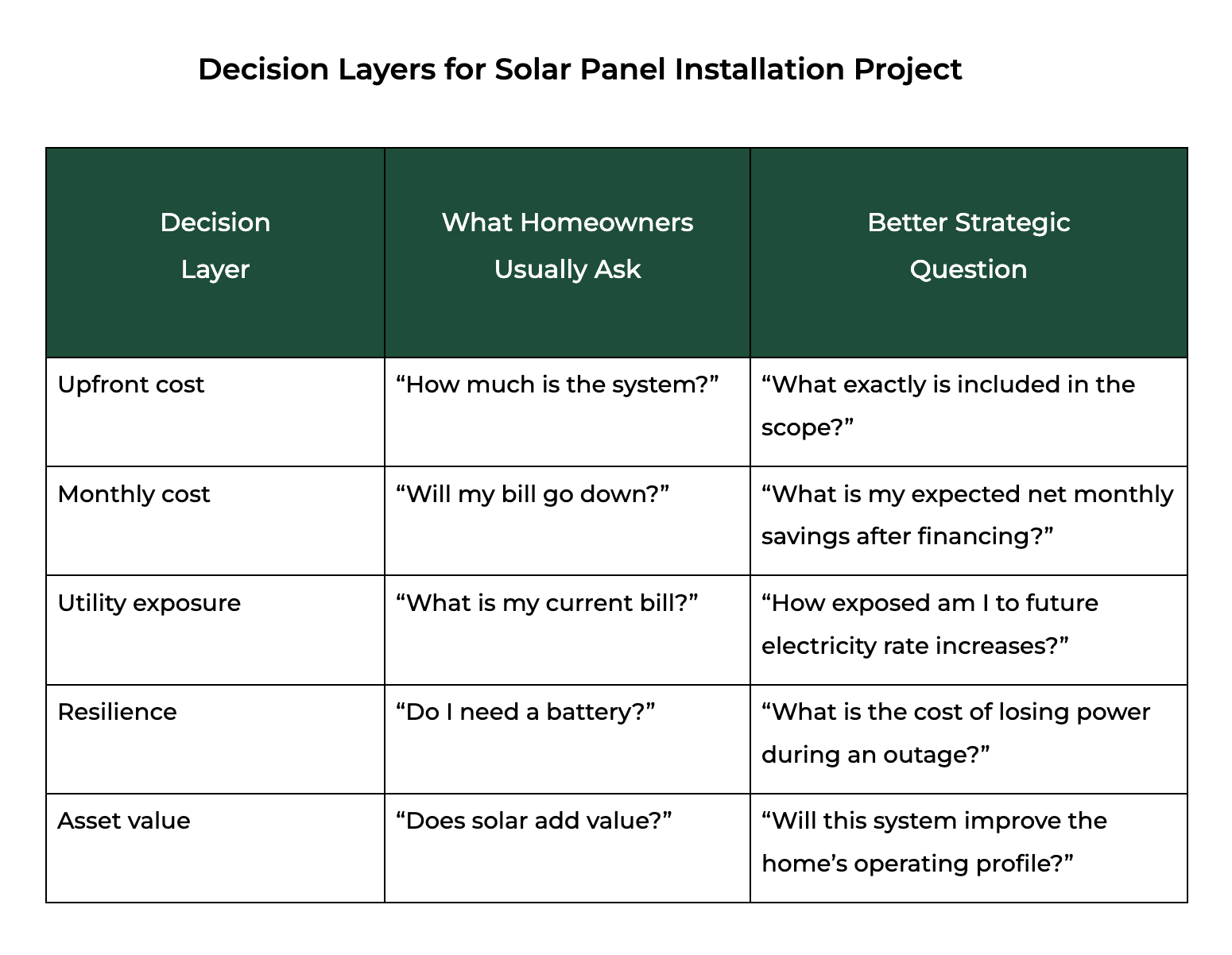
This is where solar power cost becomes a management decision. The homeowner is managing a household balance sheet. The current utility bill is the operating expense. The solar system is the capital investment. The payback period is only one metric. Risk reduction, resilience, and long-term control also matter.
For some homeowners, the lowest solar power cost will come from a simple grid-tied system with no battery. For others, the better decision may be solar plus storage, especially if backup power is a priority. The key is not to buy the most complex system. The key is to buy the system that matches the household’s actual risk profile.
What Incentives Still Matter in 2026
Many homeowners are still seeing outdated solar calculators that assume the 30% federal residential clean energy credit applies. For a 2026 article, that assumption needs to be treated carefully.
The IRS states that the Residential Clean Energy Credit applied to qualifying clean energy property installed from 2022 through December 31, 2025, and that the credit is not available for property placed in service after December 31, 2025.
That changes the 2026 economics. A homeowner evaluating Solar Panel Installation Cost in Florida after that deadline should not rely on old estimates that automatically subtract 30% from the project cost.
Florida, however, still has state-level advantages. DSIRE reports that solar energy systems have been exempt from Florida sales and use tax since July 1, 1997. DSIRE also reports that Florida provides a 100% property tax exemption for residential renewable energy property.
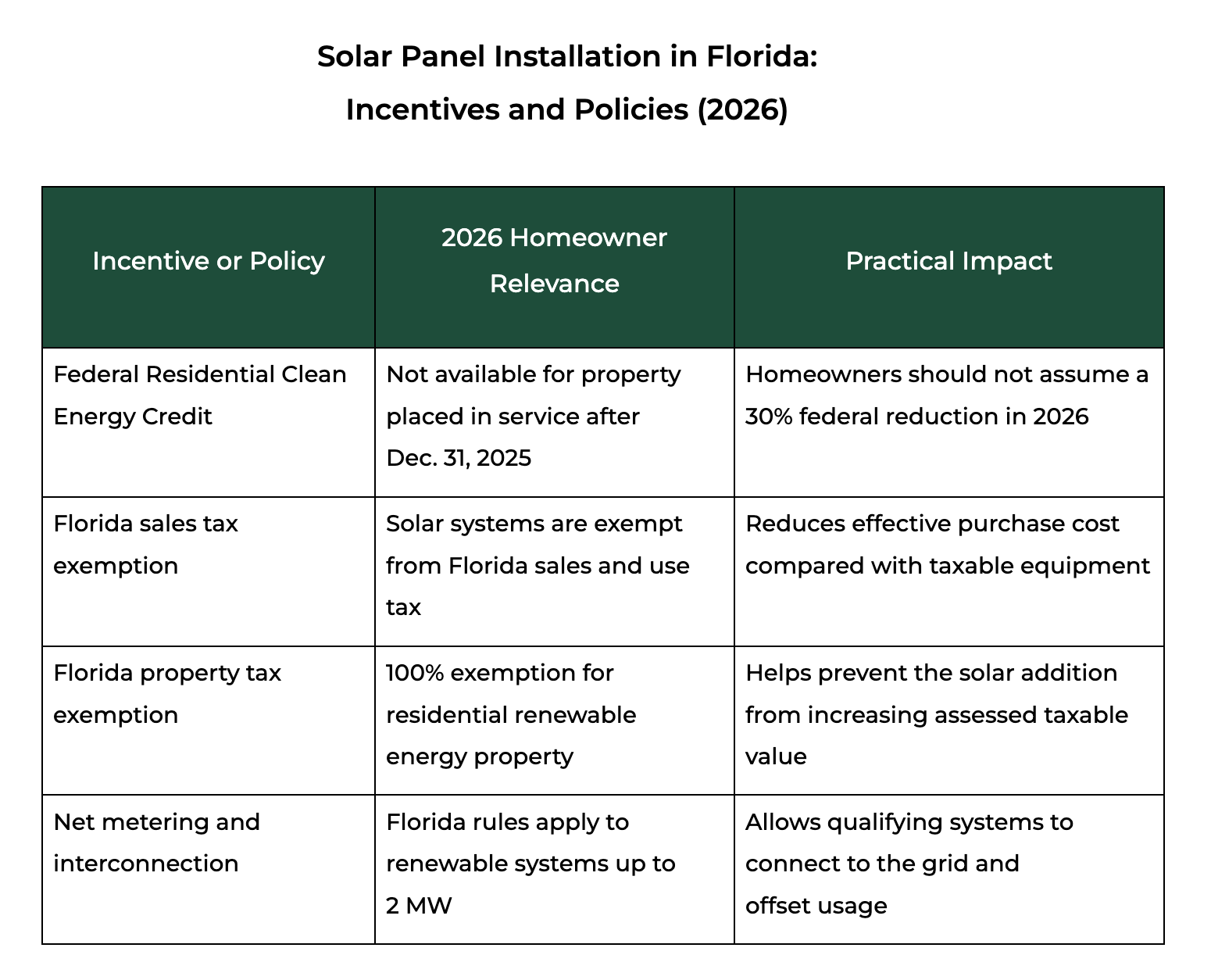
This incentive structure does not eliminate solar power cost. It changes how the cost should be analyzed.
The 2026 homeowner should be more disciplined, not less. Without the federal credit, the quality of the quote, the accuracy of the production model, and the homeowner’s utility usage profile become even more important.
Net Metering and the Real Economics of Solar
A solar system does not create value only because it produces electricity. It creates value because the produced electricity interacts with the homeowner’s utility bill.
That is why net metering matters. FPL explains that net metering allows approved customer-owned generation systems, including solar panels, to connect to the grid and offset some annual energy requirements. FPL also notes that customers must apply to become net metering customers and that the meter is replaced with one that can measure excess power supplied to the grid.
DSIRE reports that Florida’s net metering and interconnection rules apply to renewable energy systems up to 2 MW.
For homeowners, the implication is direct: solar power cost cannot be evaluated without utility assumptions. A system that produces strong midday power may look excellent on paper, but the financial value depends on how that production offsets consumption, how credits are handled, and whether the system is sized appropriately.
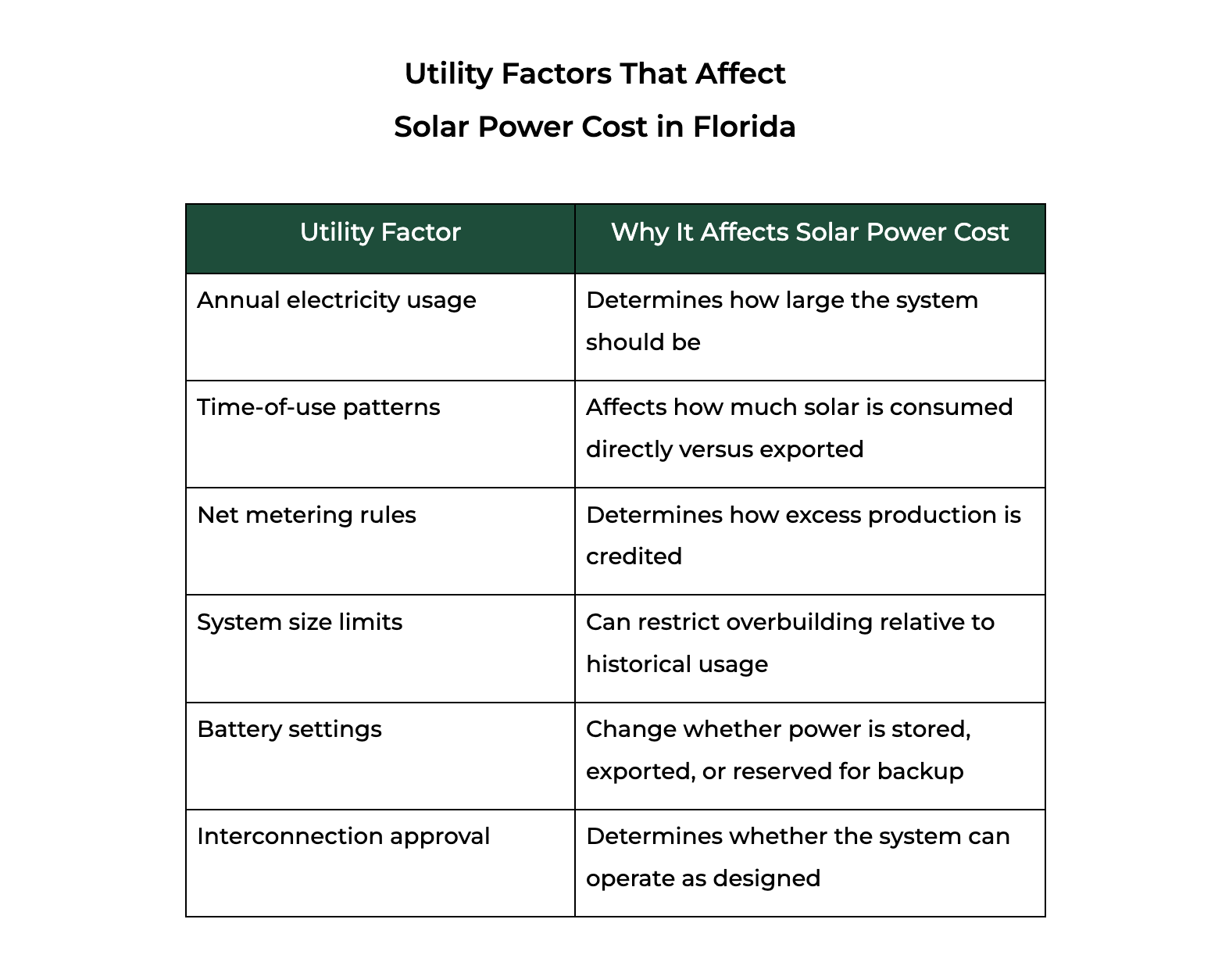
A homeowner should ask every installer for an annual production estimate, monthly production curve, expected bill offset, degradation assumption, and net metering assumption. Without those inputs, the homeowner is not comparing investments. The homeowner is comparing sales presentations.
Battery Storage: When the Higher Cost May Be Rational
Battery storage often weakens the simple payback calculation. But simple payback is not always the right measure.
A battery can provide backup power, reduce dependence on the grid during outages, and allow the homeowner to use more of the energy generated on-site. For homeowners in storm-sensitive areas, the value of a battery may be strategic even when the direct financial return is less attractive than panels alone.
The question is not whether a battery makes solar power cost higher. It usually does. The better question is whether the higher cost buys resilience that the household actually values.
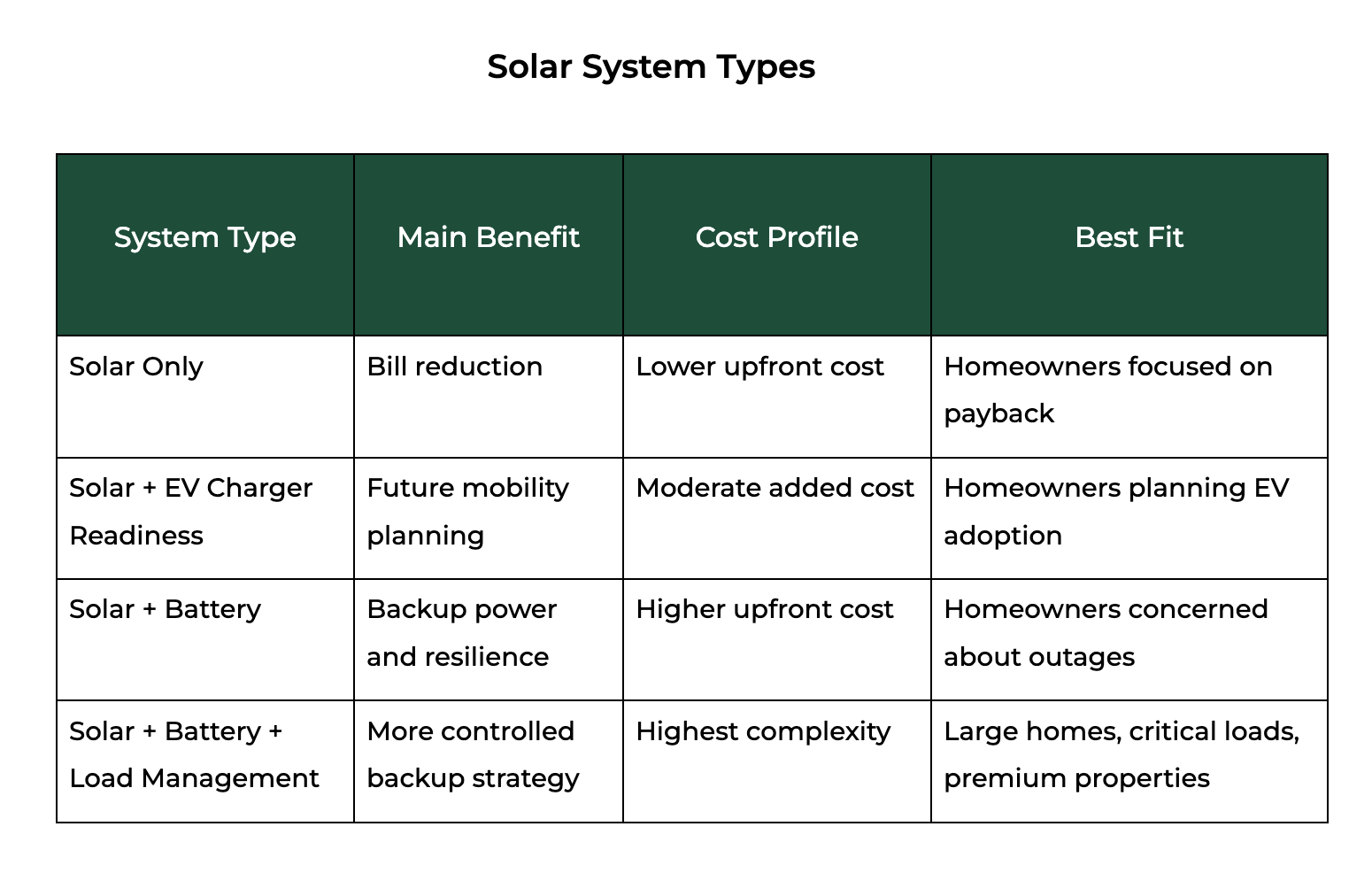
For many Florida homeowners, the decision will come down to whether they are buying electricity savings or energy continuity. Those are different products. They may use the same roof, but they solve different problems.
How to Compare Solar Quotes Like an Investor
The best way to evaluate Solar Panel Installation Cost in Florida is to compare each quote as if it were an investment memo.
That means separating price from assumptions. A quote should show system size, panel type, inverter type, estimated annual production, degradation assumptions, roof scope, warranty terms, permitting, interconnection, monitoring, and any exclusions. If a battery is included, the quote should also explain usable capacity, backup loads, operating mode, and expected performance during outages.
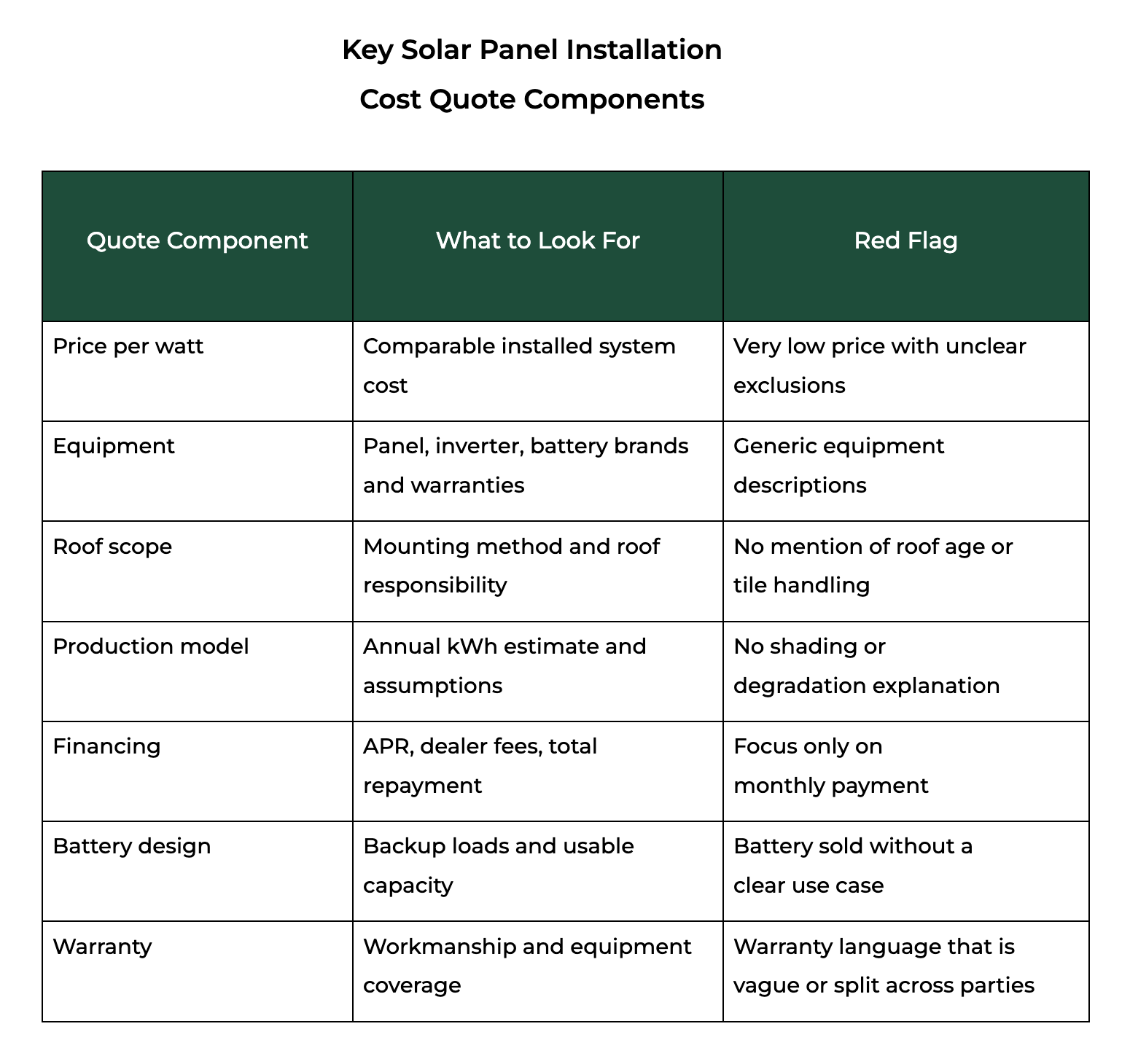
Homeowners should also compare the installer’s operational maturity. A solar project involves permitting, utility coordination, roof work, electrical work, inspection, and post-installation support. The installer is not just selling equipment. The installer is managing execution risk.
A slightly higher quote from a stronger operator may be rational if it reduces roof risk, timeline risk, service risk, and performance risk.
The Bottom Line
Solar panel installation cost in Florida is not a single number. It is the result of system size, roof conditions, electrical scope, equipment selection, battery decisions, utility rules, and incentive assumptions.
A homeowner who wants the cheapest possible system may find one. But the better homeowner decision is not always the cheapest decision. It is the clearest decision.
The right system should answer five questions.
- What will it cost?
- What will it produce?
- What utility expense will it offset?
- What risks will it reduce?
- What assumptions must be true for the investment to work?
That is why solar power cost should be evaluated as a long-term household operating strategy. Panels may sit on the roof, but the decision belongs on the balance sheet.
For Florida homeowners, the opportunity remains meaningful. The state has a mature solar market, strong adoption, sales and property tax advantages, and clear household use cases. But the 2026 market also requires more discipline. With the federal residential clean energy credit no longer available for property placed in service after December 31, 2025, homeowners must scrutinize quotes more carefully, validate assumptions more aggressively, and compare systems on total value rather than headline price.
In the end, the strongest solar decision is not the one with the most attractive brochure. It is the one where the economics, the engineering, and the household’s energy priorities all point in the same direction.
SOURCES
1. EnergySage — Florida Solar Panel Cost: 2026 Prices and Savings
2. Solar Energy Industries Association — Florida Solar and Storage Market Data
3. Internal Revenue Service — Residential Clean Energy Credit
4. DSIRE — Solar and CHP Sales Tax Exemption in Florida
5. DSIRE — Property Tax Abatement for Renewable Energy Property in Florida
6. DSIRE — Florida Solar Incentives and Renewable Energy Programs
Share This Article